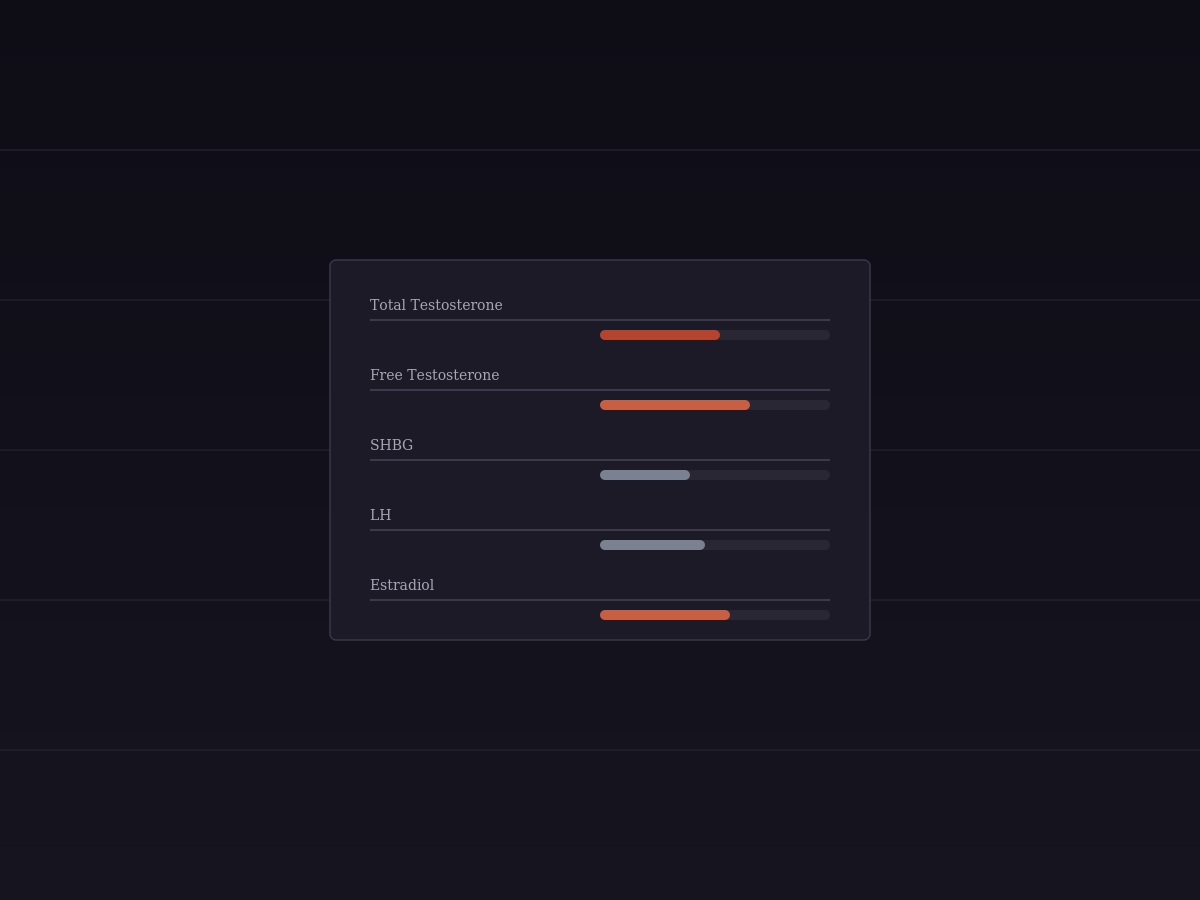
If there's one practical skill worth having on this entire topic, it's this: the ability to look at your own hormone panel and understand, in plain terms, what it's actually telling you — rather than handing it to a forum and hoping for the best.
Total testosterone isn't the whole story
This measures all the testosterone in your blood, both the portion that's bound to proteins and the portion that's freely available for your body to use. It's the most commonly ordered test and a reasonable starting point, but it doesn't tell the whole story on its own.
Free testosterone, SHBG, and LH
Free testosterone measures only the unbound, biologically active portion. Two men can have identical total testosterone numbers and meaningfully different free testosterone, depending on how much is bound up elsewhere by SHBG, the protein that keeps testosterone inactive until released.
Reading total testosterone without knowing SHBG is a bit like reading a thermometer without knowing whether it's in the sun or the shade.
LH, meanwhile, tells you where in the system a problem might originate. Low testosterone alongside high LH suggests the testes themselves aren't responding properly. Low testosterone alongside low LH suggests the signal from the brain isn't strong enough in the first place. Same low number, two different stories.
The single most important habit
One test, taken once, tells you very little on its own — hormone levels naturally fluctuate by time of day, sleep quality, and recent illness. A pattern over multiple tests, ideally taken at a consistent time in the morning, tells you vastly more than any single number in isolation.